Pillars & Dimensions
To achieve the Philippines’ AI vision and strategic goals, NAISR 2.0 is structured around two main pillars and four strategic dimensions.
It outlines seven strategic imperatives and thirty strategic tasks, guiding stakeholders across government, industry, and academia. By emphasizing innovation, fostering a robust AI ecosystem, upholding ethical standards, and preparing the workforce, it aims to harness AI’s full potential to spur economic growth, boost industry productivity, enhance public services, and improve the quality of life for all citizens.
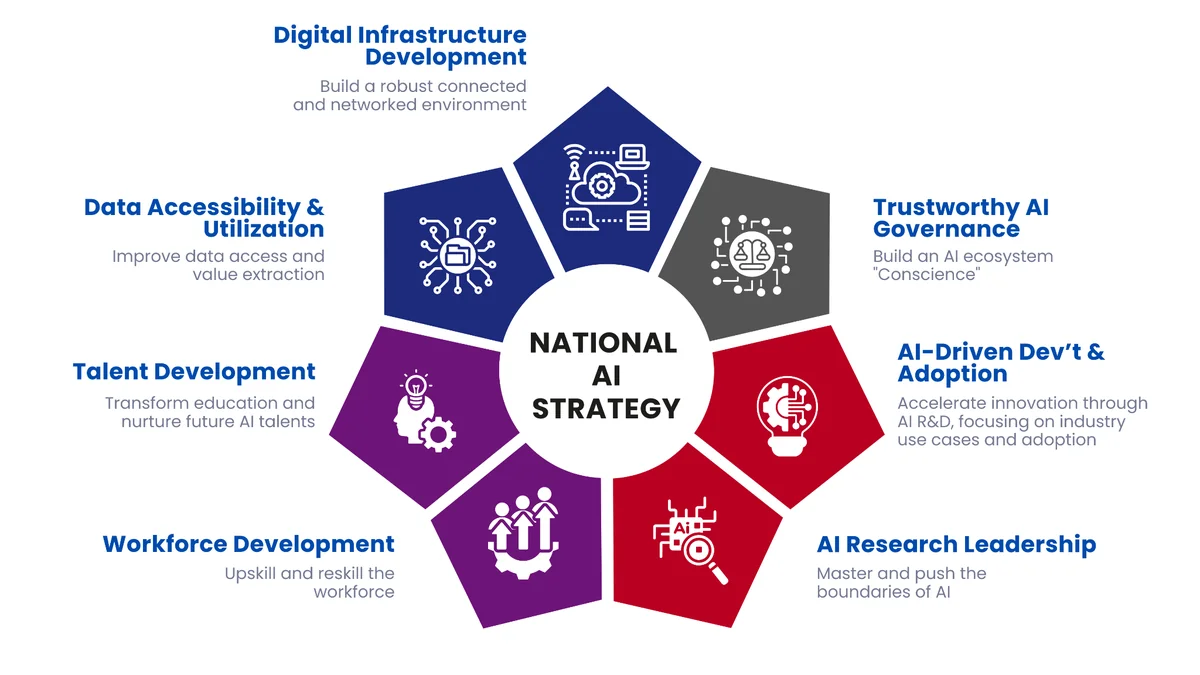
Given the rapid evolution of AI, NAISR 2.0 will undergo continuous review and adaptation to keep pace with emerging developments, ensuring a competitive AI economy and a sustainable, inclusive future for all Filipinos.
Two Pillars
Section titled “Two Pillars”The roadmap’s strategic framework draws inspiration from the Global AI Index (GAII), focusing on two fundamental pillars: Innovation and Implementation. Innovation encompasses the development of new technologies, methodologies, and research that expand AI capabilities, while Implementation addresses the practical application and integration of AI across sectors. Though the GAII includes Investment as a third pillar, this roadmap incorporates investment considerations within the Innovation pillar through R&D and commercialization initiatives.
Four Strategic Dimensions
Section titled “Four Strategic Dimensions”These pillars are operationalized through four strategic dimensions.
Under the Innovation Pillar
Section titled “Under the Innovation Pillar”The Research and Development (R&D) dimension forms the cornerstone of innovation through collaborative efforts across academia, industry, and government. Universities play a crucial role in conducting fundamental research and developing AI talent, while innovation groups within the private sector focus on applied research and commercial applications. Government research institutions contribute to public sector innovation and national priority areas. A key initiative under this dimension is the establishment of the Center for AI Research (CAIR), which will serve as a hub to foster synergistic partnerships among these stakeholders. Together, these R&D efforts aim to elevate the Philippines as a global leader in AI research and innovation, driving socio-economic growth, enhancing industry competitiveness, and improving the quality of life for all Filipinos.
Under the Implementation Pillar
Section titled “Under the Implementation Pillar”-
The Digitization and Infrastructure dimension aims to build a robust digital foundation necessary for AI development and deployment. This encompasses initiatives to enhance internet access and quality, promote data accessibility and meet computational needs. These efforts are critical for supporting AI-driven programs and ensuring that the digital infrastructure meets the demands of an AI-powered economy.
-
Workforce Development prepares current and future workforce with the skills needed to thrive in an AI-driven economy. This includes implementing reskilling and upskilling programs and developing AI and Data Science training modules.
-
The AI Governance and Ethics dimension seeks to create a supportive regulatory environment while ensuring the responsible and ethical deployment of AI. AI offers immense opportunities for development, but it is crucial to balance these benefits with potential challenges. This balance can be achieved by adhering to principles of responsible AI, which include transparency, accountability, and fairness.