Market & Investment
In an October 2020 report by EDBI and Kearney, AI is expected to boost Southeast Asia’s Gross Domestic Product (GDP) by up to USD 1 trillion by 2030. In addition, Kearney’s analysis estimates a USD 92 billion uplift in the Philippine GDP by 2030, equivalent to 12% of the economy.
With the tremendous value that AI innovations have demonstrated thus far, investors and consumers alike have been more comfortable and less apprehensive of AI uptake. New market signals validate this growing market interest in AI and predict increases in company-level capital spending on the technology.
In 2023, Goldman Sachs found that 16% of companies in the Russell 3000 had already mentioned AI in their earnings call, up from 1% in 2016. The report further reveals that 50% of which had been triggered by the launch of GenAI in 2022. In another source, Boston Consulting Group (BCG), one of the world’s largest management consulting firms, expects that 20% of its revenues will be generated from AI consultancy in 2024, a share that is expected to rise to 40% by 2026 (Financial Times, 2024).
International Data Corp. (IDC) reports that the largest organizations in Asia and the Pacific are seen to allocate more than 50% of their information technology budget for the adoption of AI starting 2025, with an insight that these companies will be AI-proofed by 2028 (Rosales, 2024).
The promising productivity gains that businesses and consumers are craving have likewise opened the floodway for venture capital to flow into the AI economy. In 2023 alone, Stanford University reported that more than 1,800 AI companies were created which received fresh funding (Figure 5).
In terms of global AI investments, 2021 was a breakthrough year as it reached more than USD 337 billion, up by 66% from the previous year. In 2023, it recorded more than USD 189 billion, marking, however, a two-year consecutive decline due to the wave of technology crunch (Figure 6).
Figure 5. Number of Newly Funded AI companies in the world, 2013-2023
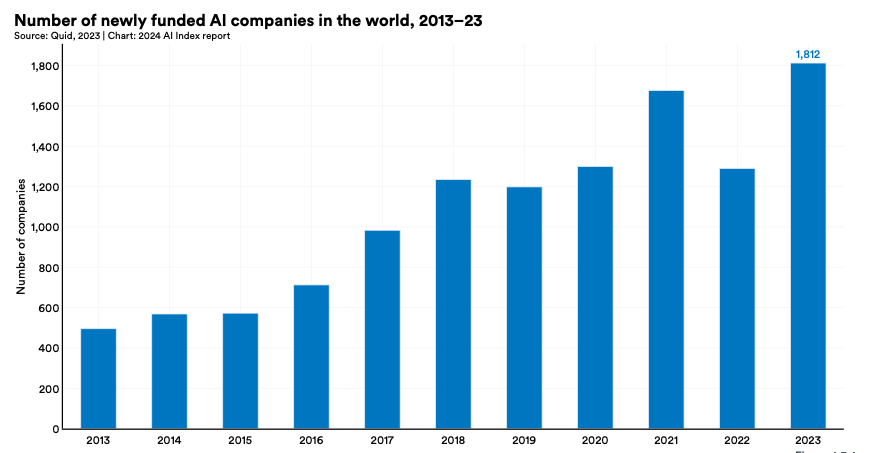
Source: Stanford University (2024)
Figure 6. Global Corporate Investments in AI by Investment Activity, 2013-2023
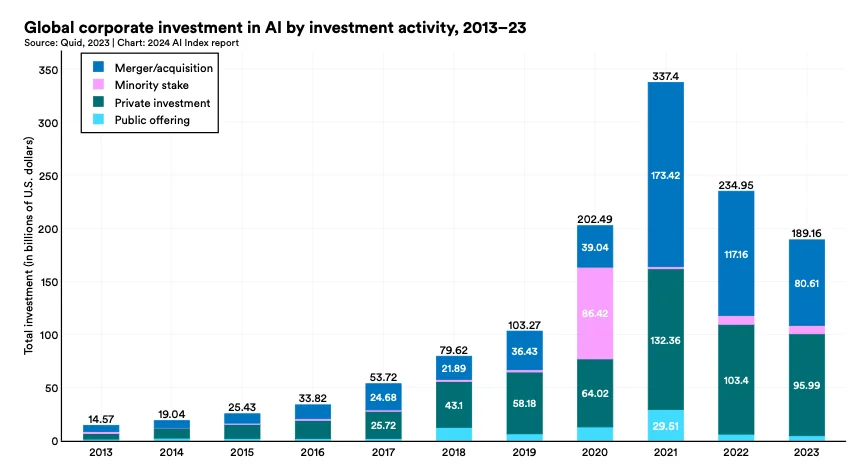
Source: Stanford University (2024)
Despite the recent declines in global AI investments, GenAI emerges as a bright spot for continued investments within the AI space, as it weathers the storm and attracts $25.2 billion in funding in 2023, nearly 9 times the investment in 2022 and about 30 times the amount from 2019 (Figure 7).
Figure 7. Private investment in GenAI, 2019-2023
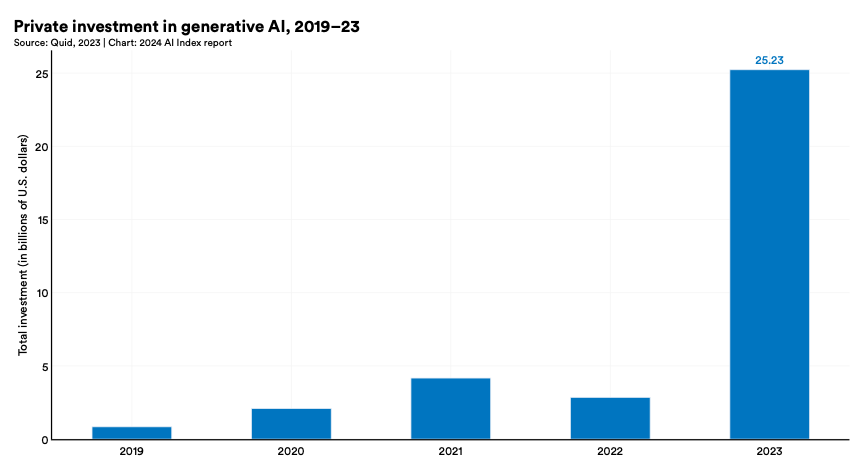
Source: Stanford University (2024)
With the rapidly expanding AI market, the Philippines sector is poised to capitalize on these vast market opportunities within the global AI ecosystem. The IT-BPM sector’s global leadership and large footprint in the global business services outsourcing is ripe for innovation and services upgrading. This development promises to deliver greater economic value and more resilient employment opportunities across every stage of the AI value chain in the Philippines.