Jobs & Labor Market
Rapid digitalization after the COVID-19 pandemic has revolutionized job structures within organizations, creating entirely new jobs and requiring new skill sets in traditional jobs. Within the next five years, digital technologies like AI will remain a key driver of business transformation with an expected net-positive outcome. In the Philippines, it is projected that 56% of workers will potentially use GenAI for 5-20% of their regular work activities. With all these changes, the World Economic Forum (WEF) (2023) predicts that six in ten global workers will require training before 2027, with a strong emphasis on creative thinking, analytical thinking, and AI and big data competencies.
Globally, it is expected that digital technologies will induce job movements for 23% of the current workforce within the next five years – either via job creation or destruction (WEF, 2023). This transformation will happen across all industries with varying magnitude, from a minimum of 16% in the Accommodation and Food sector and up to 32% in the Media and Entertainment sector.
Figure 4 depicts the magnitude of these projected labor market movements vis-a-vis the industries’ contribution to employment and value-added in the Philippines.
Figure 4. Employment, Economic Contribution, and Labor Market Movement Rate
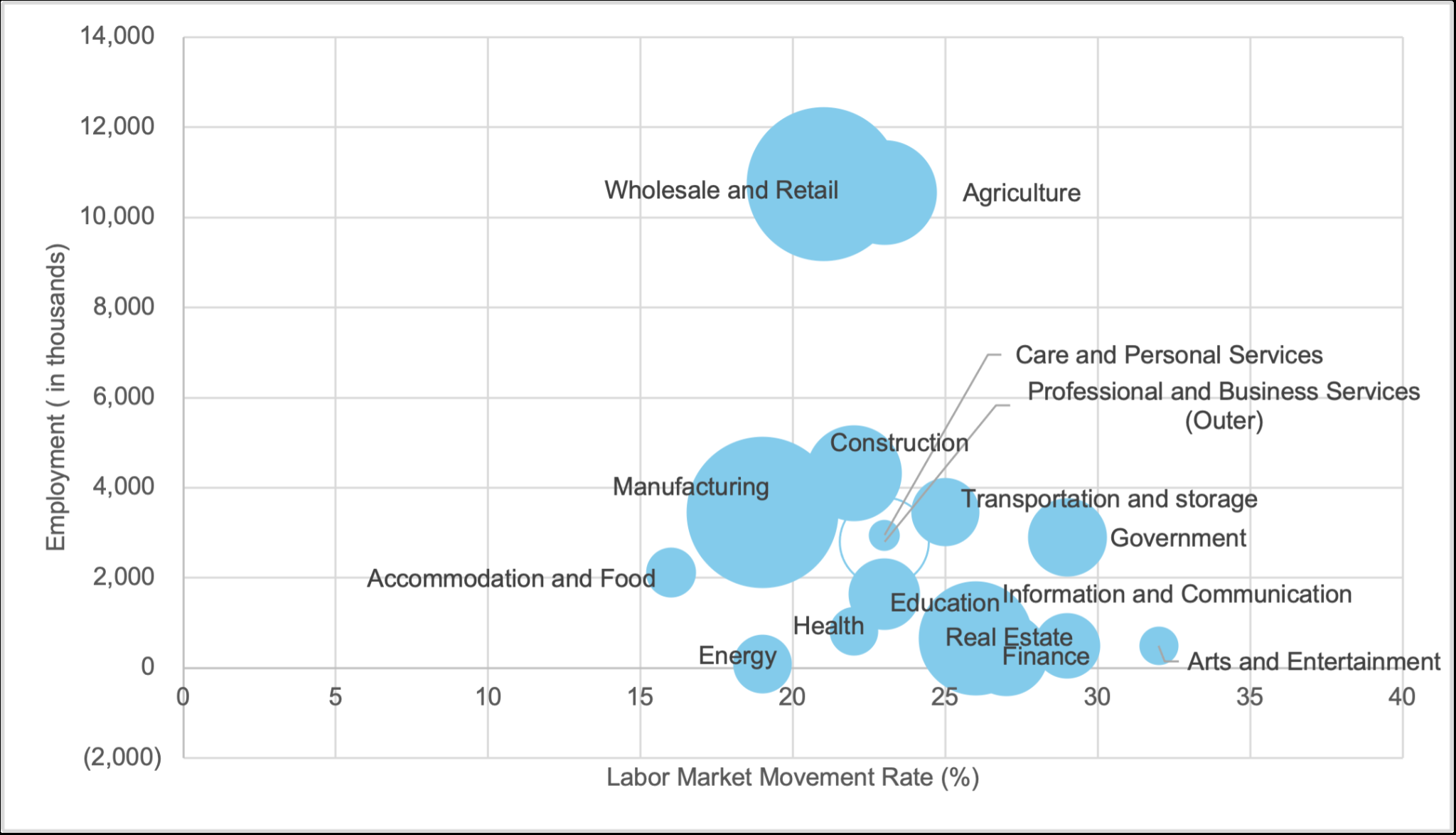
Note: Bubble size represents Gross Value Added (in constant 2018 prices). Data Source: Philippine Statistics Authority (2024); World Economic Forum Future of Jobs Report (2023). Illustration by DTI.
The two largest economic contributors, namely, wholesale & retail (18.6%) and manufacturing (18%) will experience a 21% and 19% labor market disruption, respectively.
Meanwhile, while Agriculture merely contributes 8.6% to the country’s GDP, it employs a whopping 10.5 million workers, equivalent to 22% of employment, and 23% of these jobs are expected to be transformed within the next five years.
Finally, the labor markets in the Information and Communication, and Professional and Business Services sectors, where the Information Technology and Business Process Management (IT-BPM) industry is classified, are set to be disrupted by 23% and 29% respectively. The IT-BPM sector is expected to be impacted by the automation of routine tasks and the creation of new roles in AI development and data science. For example, call centers will be disrupted by automating routine customer queries through chatbots and virtual assistants, while also creating new roles in AI-driven customer service optimization and data analytics.
At a regional level, Chitturu, Lin, Sneader, Tonby, & Woetzel (2017) reported that AI could open up opportunities in Southeast Asia in that it can “automate about 50% of the work activities performed in ASEAN’s four biggest economies”, including the Philippines.
Table 3. Employment, Economic Contribution, and Labor Market Movement Rate
| Sector | Employment Share (%) | Gross Value-Added Share (%) | Labor Market Movement Rate (%) |
|---|---|---|---|
| Agriculture | 21.9 | 8.6 | 23 |
| Manufacturing | 7.2 | 18.0 | 19 |
| Energy | 0.2 | 2.7 | 19 |
| Construction | 9.0 | 7.2 | 22 |
| Wholesale and retail trade | 22.3 | 18.6 | 21 |
| Transportation and storage | 7.2 | 3.6 | 24 |
| Accommodation and food | 4.4 | 1.9 | 16 |
| ICT | 1.0 | 3.4 | 29 |
| Finance | 1.4 | 10.3 | 26 |
| Real estate | 0.6 | 5.5 | 27 |
| Professional and business services | 5.8 | 6.3 | 23 |
| Government | 6.0 | 4.9 | 29 |
| Education | 3.4 | 4.0 | 23 |
| Health | 1.7 | 1.9 | 22 |
| Arts and Entertainment | 1.0 | 1.2 | 32 |
| Care and Personal Services | 6.1 | 0.8 | 23 |
Data Source: Philippine Statistics Authority (2024); World Economic Forum Future of Jobs Report (2023). Illustration by DTI.