Technology
Since the launch of the initial AI Roadmap in 2021, the pace of AI adoption across industries and societies has significantly accelerated, exceeding initial expectations. Rapid technological advancements, such as GenAI, have introduced new disruptions, while AI-driven products are reshaping markets and competition. This rapid evolution has led to the emergence of new job roles and the transformation of existing ones, even as policymakers grapple with the challenges of responsible AI deployment.
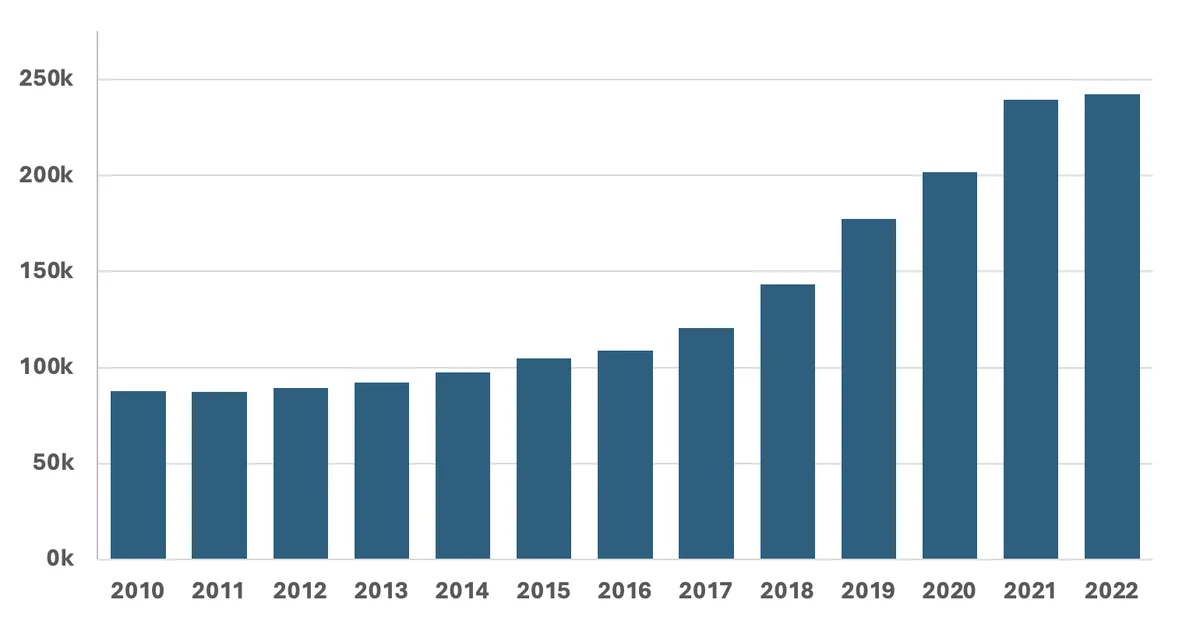
The global AI research landscape has experienced unprecedented growth, as documented in the Artificial Intelligence Index Report 2024 (Center for Security and Emerging Technology, 2023, as cited in Stanford, 2024). This growth is evidenced by the substantial increase in academic publications and patent applications. AI publications have nearly tripled since 2010 (Figure 1), reflecting increased investment and prioritization by academic institutions, industry, and governments worldwide.
Figure 1. Number of AI publications in the World
Source: Center for Security and Emerging Technology, 2023, as cited in Stanford (2024)
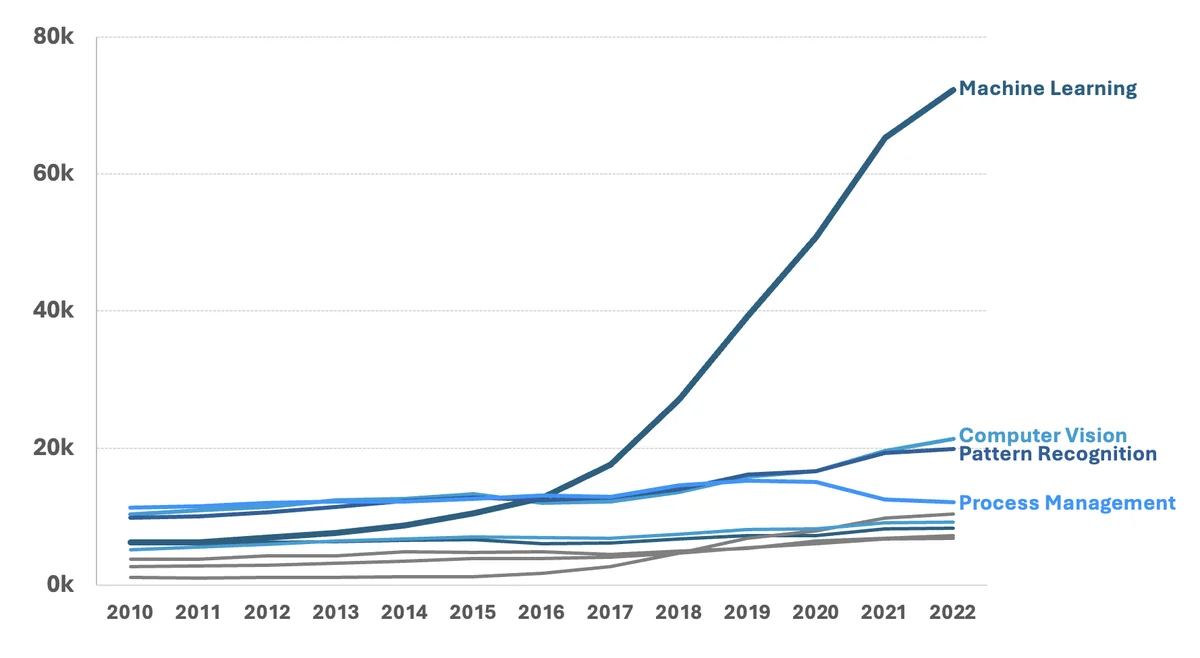
Machine learning, computer vision, and pattern recognition have emerged as dominant fields driving AI innovation, collectively shaping the development of intelligent systems across sectors (Figure 2). These systems are now capable of learning from data, interpreting visual information, and performing tasks autonomously, fueling applications across diverse sectors, from autonomous vehicles and medical diagnostics to facial recognition and beyond.
Figure 2. Number of AI by Subfield (% of total), 2010-2022
Source: Center for Security and Emerging Technology, 2023, as cited in Stanford (2024)
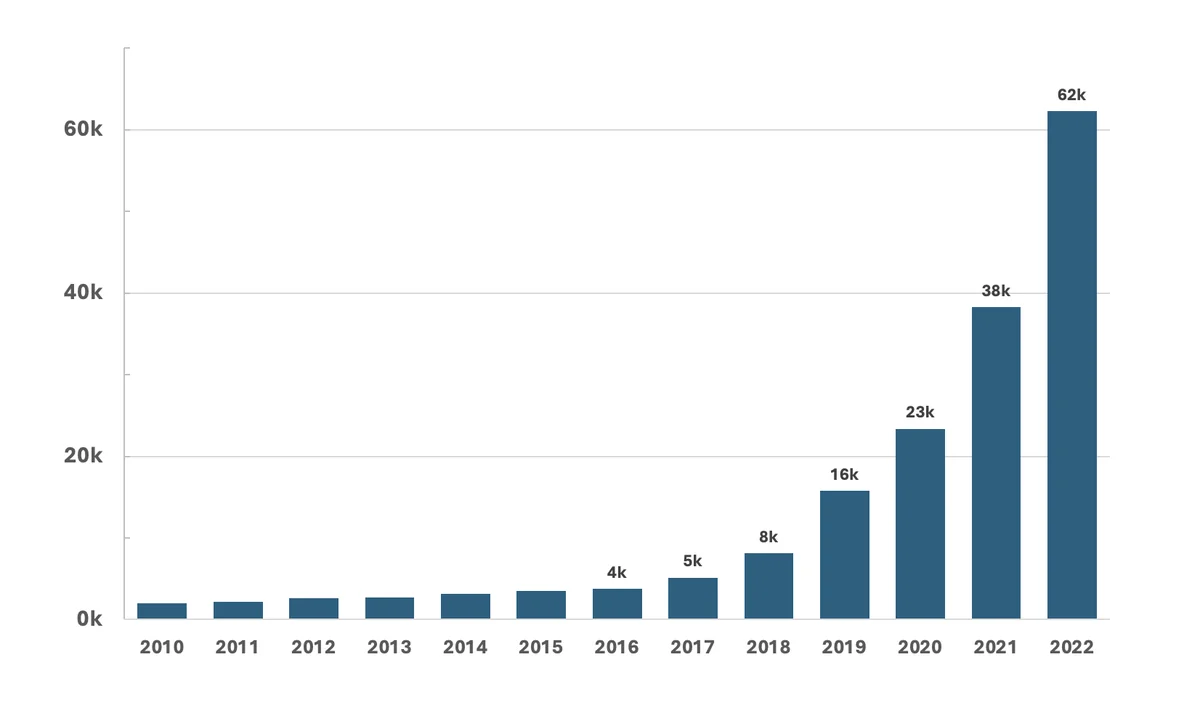
The same report also highlights the dramatic rise in AI patent registrations, particularly in 2021-2022, signals a crucial shift from theoretical research to practical applications (Figure 3). This trend reflects the increasing maturity of AI technologies and their growing commercial viability.
Figure 3. Number of AI Patents Granted, 2010-2022
Source: Center for Security and Emerging Technology, 2023 as cited in Stanford (2024)
It is also worthy to note the increasing involvement of various sectors in AI research. While academia remains a primary contributor, growing participation from industry and government underscores the recognition of AI’s strategic importance. This collaborative effort is essential for translating research into practical applications and ensuring responsible development.
GenAI, particularly large language models (LLMs) like OpenAI’s GPT models powering ChatGPT, has emerged as a major disruptive force in the AI landscape. The success of ChatGPT, along with similar LLMs such as Google’s Gemini and Microsoft’s Copilot, demonstrates the transformative potential of these technologies. Their ability to generate human-quality text is revolutionizing how organizations operate, disrupting traditional processes and driving innovation across sectors. This opens up new avenues in areas like customer service, content creation, and personalized education, promising to reshape how businesses and individuals interact with technology (Table 1).
Table 1. Generative AI Capabilities
| Capability | Description |
|---|---|
| Text | Written language outputs presented in an accessible tone and quality, with details and complexity aligned with the user’s needs |
| Code | Computer code in a variety of programming languages with the capacity to autonomously summarize, document, and annotate the code for human developers |
| Audio | Much like textual outputs, audio outputted in natural, conversational, and even colloquial styles with the capacity to rapidly shift among languages, tone, and degrees of complexity |
| Image | Textual or visual prompts lead the model to create images with varying degrees of realism, variability, and “creativity.” |
| Video | Similar to imagery, Generative AI models can take user prompts and output videos with scenes, people, and objects that are entirely fictitious and created by the model. |
| 3D | From text or two-dimensional inputs (e.g., images), models can extrapolate and generate data representing 3D objects |
Source: Deloitte (nd)
The impact of GenAI is projected to intensify in the coming years, permeating numerous facets of daily life. McKinsey (2023) reports that a significant majority of organizations already adopting AI are leveraging GenAI, with further investment anticipated. Early use cases are concentrated in areas like marketing and sales, product and service development, and service operations, but the potential spans diverse dimensions. Deloitte (nd) sees GenAI as a critical driver of cost reduction and process efficiency, fueling business growth and innovation, generating valuable discoveries and insights, and even enhancing government-citizen services (Table 2).
Table 2. Generative AI Impact
| Impact Area | Description |
|---|---|
| Cost Reduction | Reduce cost, typically by 30% or greater, primarily through automating functions and then undertaking job simulations |
| Process efficiency | Create process efficiencies through automating standard tasks and reducing manual interventions |
| Business Growth | Increase revenue generation through hyper-personalized marketing for target customers |
| Public services | Increase accuracy of various federal and local programs and create easier access for at-risk populations |
| Accelerating innovation | Increase accuracy of various federal and local programs and create easier access for at-risk populations |
| New discovery | Uncover new ideas, insights, and questions and generally unleash creativity |
Source: Deloitte (nd)
Furthermore, it has been reported that GenAI can unlock USD 79.3 billion in productive capacity in the Philippines, where 54% of the potential economy-wide gains would come from manufacturing and wholesale and retail trade (Access Partnership, 2023).
Beyond the transformative potential of GenAI, broader AI applications are poised to revolutionize specific sectors. In manufacturing, AI-driven predictive maintenance can anticipate equipment failures, minimizing downtime and driving cost savings. In agriculture, AI-powered precision farming can mitigate losses from pests and natural disasters, significantly increasing crop yields. Developing the necessary talent, technology, and infrastructure to support these advancements is crucial. This not only generates wealth but also fosters inclusivity by providing essential infrastructure – such as housing, transportation, and food security – that empowers citizens to be productive and thrive.
AI in Agriculture
Section titled “AI in Agriculture”The use of AI is gaining traction and popularity in Agriculture. Applications that can detect soil shortages and crop diseases, as well as suggest crops to plant, have been made possible by advances in computer vision and machine learning.
In addition to this, AI also supports “precision agriculture,” in which farmers employ AI to examine weather trends to forecast and schedule plantings, choose which crops are best to raise, respond to pest attacks, determine the pH and soil conductivity.
Furthermore, farmers can harvest crops faster and more effectively than human laborers because of the combination of AI and robotics.
AI in Semiconductor and Electronics
Section titled “AI in Semiconductor and Electronics”For semiconductor businesses, AI has the potential to create enormous financial value at every stage of their operations, from research and chip design to production and sales.
AI can generate $85 billion to $95 billion for semiconductor companies over the long term (Göke, Staight, & Vrijen, 2021). This is through raising the fab’s throughput, lowering costs, or enhancing yields. Moreover, AI can boost productivity and portfolio optimization for semiconductor companies when they perform research and design chips. Businesses can reduce the amount of money needed to sustain yield, prevent time-consuming iterations, and speed up the yield ramp-up by getting rid of faults and out-of-tolerance process stages.
AI in Energy and Power
Section titled “AI in Energy and Power”Energy and power industries are well-positioned to lead in utilizing the latest advancements in AI due to their reliance on data, analytics, and engineering. AI applications in the sector enhance inputs across various energy market functions, such as improving battery life performance and refining oil refinery design, while also accelerating operational improvements like enhanced digital monitoring and the use of “digital twinning” for physical energy assets as AI becomes necessary to remain competitive (Jacobs & Gardett, 2024).
AI in Manufacturing
Section titled “AI in Manufacturing”The application of GenAI in the supply chain offers the chance to significantly speed up the time from design to commercialization. Businesses are using their own data sets to train models and identify AI-enabled methods to increase efficiency and production. GenAI can also be used in predictive maintenance to identify the individual machines or lines that have the highest probability of failing in the next few hours or days.
AI in Supply Chain and Logistics
Section titled “AI in Supply Chain and Logistics”AI applications in Supply Chain and Logistics, like in most applications, drastically improves the efficiency of operations. Around 40% of supply chain organizations are already investing in GenAI (Steinberg & Burton, 2024).
Tsidulko (2024) reports applications of ML that help in mapping out logistics facilities, ensuring maximized and efficient use of space, and identifying abnormal behavior in both humans and machines far sooner than people can. As such, producers, warehouse managers, and shipping firms are teaching algorithms to identify inefficiencies in their processes, human errors, and shortcomings in their products. Cameras mounted in delivery vans, assembly lines, and logistics centers feed data into computer vision systems that employ AI to inspect work and minimize returns, recalls, and rework.
AI in Wholesale and Retail
Section titled “AI in Wholesale and Retail”AI can provide support for retail operations, increasing profits and optimizing business processes. With data being the fuel for greater AI use, stakeholders in the wholesale and retail sector can utilize consumer data to drive more targeted sales efforts (Yili, 2023). Through the analysis of data from multiple sources, AI can offer a window into the behaviors of customers and consumers by highlighting patterns, trends, needs, and preferences. AI can also suggest the best times to reach out consumers based on variables like irregular purchase frequency, decreased order size, no recent contact, etc.
AI in Mobility
Section titled “AI in Mobility”The widespread application of AI in the mobility sector is unsurprising, given its significant impact on enhancing various processes, enabling automation, and addressing long-standing challenges (Kelkar, Möller, & Ziegler, 2024). First, automobile R&D builds and manages virtual environments using applied AI so they can train the algorithms needed for autonomous driving. AI algorithms have several advantages, one of which is their ability to spot flaws in existing models. They can produce hundreds or even millions of extra scenarios for testing, an amount that would not be feasible without this technology. OEMs have enhanced manufacturing quality control by applying AI in conjunction with vision cameras, lidar, and radar. One well-known automaker, for example, uses AI-controlled robots to process each vehicle individually while upholding strict quality standards.
AI in Healthcare
Section titled “AI in Healthcare”AI has also entered the medical industry as its accuracy has increased. AI assists administrators with data processing, scheduling, file organization, and medical note transcription. AI is being used for machine-led surgeries which may operate around the clock, are less intrusive and more exact, and have a lower margin of error. Through the use of wearable technology to track health and identify issues before people become aware of them, AI can help with medical diagnosis. AI has also been used by some programs to read body scans (such as MRIs) and detect dangerous medical conditions more quickly and accurately.
AI in Education
Section titled “AI in Education”Even though human workers still hold a major role in education, AI helps teachers efficiently carry out their tasks and functions. AI is frequently utilized to enable automation in repetitive, data-intensive operations such as assigning grades for homework, setting up meetings, overseeing several online courses concurrently, personalized messages being sent to students, and making or digitizing study materials and lectures.
AI in Finance
Section titled “AI in Finance”The application of AI in finance has also become increasingly prevalent. AI can be used by customers to obtain information about their investing and banking accounts. Similarly, AI is used by banks and credit card companies to identify trends in transactional data and identify fraudulent activity early on.
AI is also used by lenders to forecast and evaluate the risk levels of their borrowers and make loan choices. Likewise, AI is used by venture capital organizations to provide tailored insights and financial risk management choices.
AI in the Creative Industries
Section titled “AI in the Creative Industries”We are witnessing augmentation experiments in more creative work since the advent of GenAI (De Cremer, Morini Bianzino, & Falk, 2023).
Designers, filmmakers, and advertising executives have been adopting image generators like DALL-E 2, MidJourney, and Stable Diffusion more recently. Rather being seen as a threat, GenAI software is seen as a tool allowing humans to do the work they already perform, but simply accomplish their tasks with greater speed and efficiency.
GenAI enables video game developers and animators to explore exciting new possibilities to produce realistic graphics, immersive gameplay, and captivating content (Marr, 2024). Game developers and animators can extensively use AI in procedural and terrain generation as well as automated modeling, vastly improving their efficiency.
Web design is also greatly improved by AI as it can streamline the design process, enhance user experience, and optimize performance and accessibility for many users and stakeholders.